Saturday, 21 March 2015

The Use of Wood in the 12th Century, by Bertram

Wood. Where to start with wood?

Well, it is one of the most commonly used and grown resources in my time and, I'm sure, in yours! Here in Furness we have many woodlands near our towns and villages and these woodlands are used readily to collect timber for a huge variety of uses.

Bertram's wooden creations

Here are just a few example of how we use wood:

  • To build our houses. Wood is used to create the base frames for our homes and buildings. We also use willow and hazel branches to weave in our walls before covering them in daub (horse dung, clay and straw).
  • To create our furniture. Wood is used to make any furniture we can afford, such as tables, chairs or stools. Being a peasant I can't afford much of this!
  • To make utensils. Wood is used to make a large selection of utensils from spoons to bowls.
  • To make tools. As utensils wood is used to make many different tools from mallets to textile weaving and net making tools.
  • To make toys. Wood is used to make many different toys for children to play with including toy dolls.
  • To build boxes and chests for storage. We all need storage solutions and for us boxes and chests are some of the best and wood is used to build them.

As you can see we do use wood, a lot! It is one of the most durable as well as cheapest resources to be found. Metal is a fantastic resource but it is very expensive. To create usable metal objects takes a massive amount of work; taking rocks, smelting them to get iron then blacksmithing it to create objects. It is not an easy process! But wood is easily accessible for all and easier to manipulate, although it is still a skill to work it well.

Tools for Working Wood

Woodworking tools
You can use many different tools to work wood but there is one tool that is a must; an axe! Axes are not only used to chop down trees but to also split and shape wood. There are many varieties of axe for various jobs, you can see a T-axe pictured here along with a selection of other tools. This is a small hand axe, perfect for shaping wood before further work. I use this to shape my bowl blanks ready to go on my lathe. The other tools seen here are a draw knife- a flat blade with two outer handles, this can be used by pulling the blade towards yourself to shave wood. A chisel- another staple for wood workers, chisels are used to remove wood and cut into wood. A twist auger- a small hand drill which can be used in a turning motion while applying pressure to drill a small hole. Two gouges- both used to gouge into wood, great for creating the bowls in spoons.

Bertram on his lathe
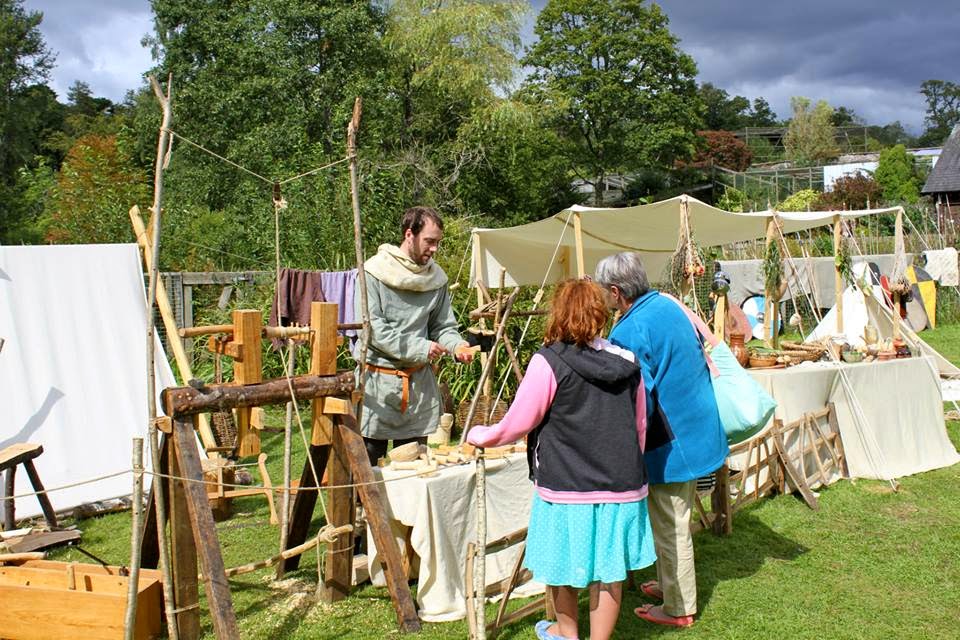
Woodturning, something I specialise in, is often undertaken in my time and is a way of creating usable objects, like bowls, by turning the raw material to shape it. The pole lathe is used to do this. A pole lathe is a piece of machinery, or a tool if you prefer, which uses a pole or two of green, flexible wood with rope attached to both the pole and a pedal. Pushing the pedal pulls the rope which in turn pulls the pole to create energy which can turn a piece of wood.

You can see here (left) myself turning a bowl. Attached to the wood being turned is another piece called a mandrel, of which the rope is wrapped around. This means that when the rope is pulled it turns the wood rapidly back and forth, with this motion you can then cut into the raw material, on the down turn, using a metal tool called a hook chisel. This is a long metal shaft with a hook on its end, this hook is sharp  and is what cuts the wood. Eventually, with a lot of work, patience and sweat you can end up with a bowl or another lathed item. I have used the lathe to create bowls, spoons, toy dolls and even other tools.

The pole lathe is a remarkable piece of machinery which has been around for many centuries. It's a simply constructed bit of kit which can do a powerful job and it is almost completely made from wood itself!

A basic stool
Some Examples of Wood Use

Furniture Making:

You can make many different types and variations of furniture with wood. From high end tables and chairs for the lords and ladies of the land to much more humble and basic furniture, like stools, for the common folk like my good self. Seen here (right) is a simple stool made from just four pieces of wood in a short amount of time. The top, or seat, is a piece of split log and the legs are three small branches. The branches are shaved at the top and slotted into holes drilled in the split log. Simple but effective! You may note that it is three legged, this is because three legs can sit better on rough ground and trust me, we have a lot of that around here! Of course using these same principles you can make tables, something often needed.

Wooden spoons
The making of spoons:

Spoons are commonly used across the country and are mostly made from wood. Only the wealthy can afford metal spoons and personally I think wooden ones are much better! They are easy enough to make, take a log, split it a few times to get some nice planks then either cut or shave it into shape. Finally carve out the bowl of the spoon and there you have it. Of course you can even turn spoons making lovely handles and deep bowls.


Wooden Children's Toys
Toys:

Ah, toys. Something we all have in some form when young. In our time toys are not only used for play but also for learning. Things like dolls can be used for young girls to play with but also make clothes for, thus learning the skill of sewing, something vital for later life. Toys like horses and spinning tops are also commonly made for play. Spinning tops often made from the discarded centers from bowls.

There are so many uses for wood it is hard to fit them all in here but hopefully these few examples will give you an idea of its importance in my time.

Wood is a durable, beautiful resource which I adore. Its uses are endless and without it where would we be?

Until next time,

Bertram


Bertram's Bio:

Born near Daltune (Dalton-in-Furness) in 1116 Bertram had a hard start to life working the farm lands with his parents and brother Ernolf. In his teenage years he developed a passion for woodwork and enhanced his skills on a pole lathe. Now, when he isn't working the land, he travels the county selling his wares where he can to earn a crust. Making all sorts of wooden objects from bowls to spoons and even toys Bertram has gained a reputation for quality goods in many parts of the county and just about manages to stay afloat. 


Thursday, 20 November 2014

Iron Shepherds Living History Turns Two!

Another year passes for Iron Shepherds and plenty has happened over it; from new displays to new events and exciting opportunities!

December 2013

Medieval Camp at a Christmas Fair | 01.12.2013

Our second year started off at a leisurely pace with our first event being another winter fair at Abbey Mill Cafe. We had a small camp set up where we spent the day preparing food, showing some crafts and generally trying to keep warm! It may look realitivly warm in the picture but it was a typical freezing winters day. Luckily we did have the fire to sit by and warm us up but our feet did get a little numb. Even so it was a great little day and a wonderful start to our second year before going on a little break.


 Following the winter fair we went on a break from events for the rest of the winter while we gathered ideas and worked on the summer to come!

May 2014

Monks at Furness Abbey | 05.05.2014

Brand new for 2014 Iron Shepherds introduced our Monks Life Display, a display tailor made to showcase different aspects of a monks everyday life from when they got up, to what they ate and what chores they had. The setting for our first Monks Life event was amongst the beautiful ruins of Furness Abbey. Sat in the cloister range we had a small display which had Brother Bertram demonstrating and talking about cooking, Brother Oswald net making, Brother Orm Tethera discussing everyday life, Brother Fulk giving insight into the lay brothers and Brother Ralph informing about surgery and health. The day saw a fair number of people coming to see us and learn about the Monks of Furness Abbey in an interesting and visually engaging way!


Monks Life at Furness Abbey | 24.05.2014

A few weeks after our first Monks Life event we were asked to do it again at Furness Abbey to coincide with some shuttle buses that were running on the 24th between the Abbey and the Dock Museum in Barrow. It was the perfect time to have a little extra going on in the ruins so we jumped at the chance to go down and set up our display again. This time, along with the original Brothers, we had a visiting Nun, Sister Æowyn and Brother Mellitus joined us to display ink making. The day was wonderful and we had lots of visitors from the shuttle buses as well as general tourists! 


June 2014

Holker Garden Festival | 30.05-01.06.2014

At the end of May we had the opportunity to have a small display at the Holker Garden Festival, and opportunity we jumped at! We had a small area to set up in to advertise ourselves so Bertram, Anna and Brother Orm Tethera headed up to the Festival to demonstrated some crafts, wares and entertain the crowds. We had lots of interest and positive feedback which was a real boost on the long hot days! We were in a tent which made it extra warm!


Dalton Carnival | 14.06.2014


A different sort of event for us this. We had been asked to be involved in the 2014 Dalton Carnival so that the carnival theme could be Medieval. We were happy to be involved and on the 14th we set up camp on Dowdales School field and then some of us went off to be in the parade! Brother Orm Tethera was joined by Oswald, Aelswyth and family to lead the parade through the streets of Dalton. Brother Tethera had quite a lot of fun engaging with the onlooking crowds! After the parade we performed our weapons display before everyone rejoined the camp to show off our crafts. It was a nice little day with masses of people enjoying the festivities. We had quite a fair amount come over and talk to us which made the day pass well.


 Family Fun Day at Gleaston | 28.06.2014

The end of June came and we had been invited to have a display at the Gleaston Family Fun day. The event lasted 4 hours from 12pm and we were there with our Anglo Norman camp to do what we do best, display crafts and engage with the public! We had a great day and spoke to many people who all showed an interest in what we had on show. Throughout the afternoon bowls were turned, nets were made and stone was carved!


August 2014

Muncaster Castle Living History Week | 19-20.08.2014

Here we are again, back for one of our big shows of the year at Muncaster Castle Living History Week! We set up camp for two days of education, entertainment and medieval fun and it was a real success!


Hundreds of people flocked in over the two days and wandered our camp asking questions, listening to explanations and enjoying the atmosphere of Anglo Norman life. We had many positive comments about what we were doing which really made the days worth while. The crowds for our weapons displays were a bonus too!


On our first evening at Muncaster, as we set up camp, we did a time-lapse video to show in speedy fashion how we erect our camp. It's certainly a fun little watch-


Medieval Fair at Furness Abbey | 30.08.2014

30th of August and it's time for another of our biggest events of the Summer, the Medieval Fair at Furness Abbey! And it didn't disappoint!


10am and the doors opened on the second ever Medieval Fair. Camp had been set up the night before and we were all up and ready for the public who soon arrived in their droves. There was a steady flow of people through out the day, walking through camp, chatting to us about our crafts and life in Anglo Norman Furness. We also performed our weapons display 3 times through the day to large crowds enlightening them to what weapons were used in the time as well as entertaining them with some brawls. 


While at the Abbey fair we also filmed another time-lapse video! This video was taken throughout the whole day, from 10am until about 6.30pm, and gives an idea of the numbers of people who flocked to the event and came through our camp!


October 2014

The Room of Curio at Wray Castle | 30+31.10.2014

And so arrives our final event of the year for us, a brand new venture created specially for Halloween; our Victorian Room of Curio! Showcased for the first time at Wray Castle during their halloween celebrations the idea was devised as a way to engage the public by telling them local stories and legends while also entertaining them with a couple of scares along the way. We had timed entry to the room throughout the two days where Curio Master, Dalton Mills, would take people round. We were booked up for all our entries with 160 people, young and old, entering the room over the time. Everyone left the room happy, entertained and a little bit scared and we received some really positive comments! Dalton Mills was certainly pleased with the reactions to his stories and curiosities.


It has been a fantastic year for us with so many new and exciting events as well as returning to some of our favourites. Thank you to all who have supported us, booked us and come to see us this past year. We have had a great time and are extremely excited to see what the next year brings, we certainly have some interesting ideas ...

If you would like to keep up to date with what the Iron Shepherds are doing then why not follow us on Facebook or Twitter  You can also check out our website to discover what we do and what we have coming up.