Showing posts with label Monks Life. Show all posts

Tuesday, 3 May 2016

The Timetable of a Monk | Life in the Past Festival

The lot of a medieval monk living in one of the many abbeys across Britain was not an easy one. Men did not become monks for an easy life, they became monks to worship the lord with their work, prayer and devotion. They often perceived themselves as soldiers engaged in a spiritual war against their imperfect, fallen nature. This made for a hard life with each day was a long one, packed full of worship and work.


What follows is the basic timetable for a Cistercian choir monk living in a medieval abbey during the summer months:


2.00am –         A choir monks day would start early with the first of 8 services, Matins. The monks would gather in the church and stand in the choir stalls. Here they would celebrate the night office with singing. Two monks, the precentor and succentor, lead the singing and keep their eyes on the other monks to make sure no one nods off.

2.45am –         Matins ends and the monks can rest in the cloister for a time. Sadly they aren’t allowed back to bed.

3.00am –         Monks return to church for Lauds, the second service of the day. This one is to celebrated daybreak.

3.15am –         Lauds ends and the monks can return to the cloister to read for 45 minutes.

4.00am –         At sunrise it’s time for Prime to mark the first hour of the day. Another short service lasting only 15 minutes.

4.15am –         It is now time for the chapter meeting. Monks would meet in the chapter house daily. They would sit on benches around the walls while they watch and listen to the Abbot as he says a prayer and reads a chapter of the Rule of St Benedict.

Following this all the monks must confess there faults and sins. They would then be punished accordingly often having to lie flat on the ground in front of the others, a practice known as prostration. In some cases some may have to fladulate, in other words whip, themselves.

Announcements follow this and the meeting ends with Psalm 129 and prayers before tasks are given out to all the monks.

4.45am –         The monks leave the chapter house to go about their daily tasks for around 2 and a half hours

7.30am –         Time for the monks to return to the cloister for half an hour of reading.

8.00am –         Terce, the third service of the day. The monks return to the church to take up position in the choir stalls. Mass is this time spoken for the monks to listen too and once a week wine and bread are taken to symbolize the body and blood of Christ.

9.00am –         Monks return to the cloister for further reading although priests stay in church for private mass.

11.00 am –      Church again for the forth service of the day, Sext. The name sext comes from latin for six and it is so called because it was originally celebrated on the sixth hour of the day.

11.30am –       Time for dinner. All the monks gather in the refectory, or frater, where the main meal of the day is served. They stand for blessings before sitting down to eat. Beans covered in vegetable juice is often popular at this time and each monk has a serving of bread for the day, their daily bread. Over the course of the meal a monk stands in a large pulpit and reads from scripture.

12.00pm –       Following dinner the monks join the procession of thanksgiving in the church before being allowed to take a nap in the dormitories or read.

2.00pm  -        Now comes the time for None which involves more singing in the church.

2.30pm –         Following None the monks return to their work, be that in the kitchen, out in the herb gardens or working the land with the lay brother. This last for around 3 and a half hours.

6.00pm –         A return to church for Vespers, the seventh service of the day.

6.30pm -         During the summer months monks are allowed two meals a day and now is the time for the second, although it isn’t as big as the first. They are given vegetables and fruit to eat with whatever is left of their daily bread.

7.15pm –         The collation reading. Monks gather in the north cloister walk and listen to a reading by the reader of the week.

7.30pm –         Back to church for Compline, the last service of the day. At the end of this services the abbot sprinkles the monks with Holy Water.

8.00pm –         Bed time. After a long and tiring day of work, reading and singing the monks are allowed to return to bed for six hours of sleep.  Then it’s time for Vigils again and the start of another day.


As you can see there is a lot for a monk to fit into his day and it certainly isn’t an easy life for them. The days were long with out much rest, meals were scarce and not the most delicious. Nearly every day was spent in the same way never leaving the precinct wall of their monastery. Is it a life you would want to lead?


Wednesday, 27 May 2015

Making a Writing Quill

Quills were one of the dominant forms of writing throughout the Medieval period. Made from the feathers of common birds, like geese and ducks, quills were easy to make and worked brilliantly well.

Monks living in monasteries, like the Abbey of St Mary's in Furness, would use quills on a daily basis to write copies of scripture while sat in the Cloister Range. At our upcoming event, Life in the Past, during our Meet the Monks day (7th June, 11am - 5pm) you can have a go at writing with one of these wonderful writing implements.

This is how such a quill is made:

Step 1

Take a feather, the one I am using is a white duck feather. You then can cut away some of the feather's barbs (the main body of the feather). I leave some at the top, mostly for decoration.


Step 2

Now it's time to start shaping the nib of the quill, the bit that will do the writing and hold the ink. Feathers have a hollow shaft towards the bottom, this is perfect for creating an ink well which will hold the ink while writing.

It's time to cut the end. Take a sharp knife and take an angled cut down towards the end of the shaft. Following this cut again in a steeper angle nearer the end and shape the nib.


Step 3

Once the nib has been shaped cut a slit down the centre of the nib. This will allow the ink to flow down the shaft to the parchment. Once this has been done you have a new, working, quill. Ready for writing with.


Feather Quills are wonderful implements to write with. It really makes you appreciate the art of writing, that is of course if you can write. In our time not everyone was literate or able to write. Monks were well educated and wrote everyday but peasants would, mostly, never write or read.

800 years ago this year, in 1215, the Magna Carta was written with feather pens just like this!


Come see us on the 7th of June at Furness Abbey to have a go writing with one of these quills at our Meet the Monks display and discover what life was like for Monks in the 13th Century. You can also come and see us at our Meet the Peasants day on the 6th June to learn more about life in the 12th Century.


Tuesday, 14 April 2015

Life in the Past Announced

We are very pleased to announce a brand new event developed by Iron Shepherds called Life in the Past! This two day event will be taking place amongst the ruins of Furness Abbey on 6th and 7th June 2015 from 11am - 5pm.


Day 1 - Meet the peasants and find out about their daily lives, how they farmed and how they worked. You can also watch a specially written mummers play to end the day!

Day 2 - Meet the monks and discover what life was like living in a Medieval abbey. There is also chance to meet some visiting nuns and take a tour of the holy site by one of the monks!

We are really excited to share this event with you and hope to see you there! Keep an eye out for further details as we release them by checking out our Facebook and Twitter.

Also take a look at our dedicated webpage ironshepherdslivinghistory.co.uk/lifeinthepast


Thursday, 20 November 2014

Iron Shepherds Living History Turns Two!

Another year passes for Iron Shepherds and plenty has happened over it; from new displays to new events and exciting opportunities!

December 2013

Medieval Camp at a Christmas Fair | 01.12.2013

Our second year started off at a leisurely pace with our first event being another winter fair at Abbey Mill Cafe. We had a small camp set up where we spent the day preparing food, showing some crafts and generally trying to keep warm! It may look realitivly warm in the picture but it was a typical freezing winters day. Luckily we did have the fire to sit by and warm us up but our feet did get a little numb. Even so it was a great little day and a wonderful start to our second year before going on a little break.


 Following the winter fair we went on a break from events for the rest of the winter while we gathered ideas and worked on the summer to come!

May 2014

Monks at Furness Abbey | 05.05.2014

Brand new for 2014 Iron Shepherds introduced our Monks Life Display, a display tailor made to showcase different aspects of a monks everyday life from when they got up, to what they ate and what chores they had. The setting for our first Monks Life event was amongst the beautiful ruins of Furness Abbey. Sat in the cloister range we had a small display which had Brother Bertram demonstrating and talking about cooking, Brother Oswald net making, Brother Orm Tethera discussing everyday life, Brother Fulk giving insight into the lay brothers and Brother Ralph informing about surgery and health. The day saw a fair number of people coming to see us and learn about the Monks of Furness Abbey in an interesting and visually engaging way!


Monks Life at Furness Abbey | 24.05.2014

A few weeks after our first Monks Life event we were asked to do it again at Furness Abbey to coincide with some shuttle buses that were running on the 24th between the Abbey and the Dock Museum in Barrow. It was the perfect time to have a little extra going on in the ruins so we jumped at the chance to go down and set up our display again. This time, along with the original Brothers, we had a visiting Nun, Sister Æowyn and Brother Mellitus joined us to display ink making. The day was wonderful and we had lots of visitors from the shuttle buses as well as general tourists! 


June 2014

Holker Garden Festival | 30.05-01.06.2014

At the end of May we had the opportunity to have a small display at the Holker Garden Festival, and opportunity we jumped at! We had a small area to set up in to advertise ourselves so Bertram, Anna and Brother Orm Tethera headed up to the Festival to demonstrated some crafts, wares and entertain the crowds. We had lots of interest and positive feedback which was a real boost on the long hot days! We were in a tent which made it extra warm!


Dalton Carnival | 14.06.2014


A different sort of event for us this. We had been asked to be involved in the 2014 Dalton Carnival so that the carnival theme could be Medieval. We were happy to be involved and on the 14th we set up camp on Dowdales School field and then some of us went off to be in the parade! Brother Orm Tethera was joined by Oswald, Aelswyth and family to lead the parade through the streets of Dalton. Brother Tethera had quite a lot of fun engaging with the onlooking crowds! After the parade we performed our weapons display before everyone rejoined the camp to show off our crafts. It was a nice little day with masses of people enjoying the festivities. We had quite a fair amount come over and talk to us which made the day pass well.


 Family Fun Day at Gleaston | 28.06.2014

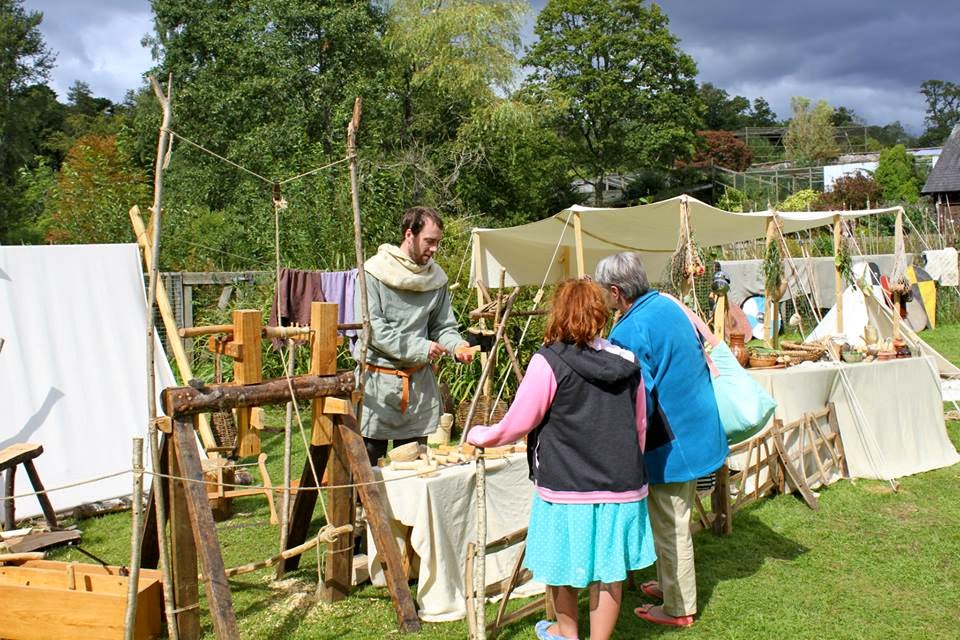
The end of June came and we had been invited to have a display at the Gleaston Family Fun day. The event lasted 4 hours from 12pm and we were there with our Anglo Norman camp to do what we do best, display crafts and engage with the public! We had a great day and spoke to many people who all showed an interest in what we had on show. Throughout the afternoon bowls were turned, nets were made and stone was carved!


August 2014

Muncaster Castle Living History Week | 19-20.08.2014

Here we are again, back for one of our big shows of the year at Muncaster Castle Living History Week! We set up camp for two days of education, entertainment and medieval fun and it was a real success!


Hundreds of people flocked in over the two days and wandered our camp asking questions, listening to explanations and enjoying the atmosphere of Anglo Norman life. We had many positive comments about what we were doing which really made the days worth while. The crowds for our weapons displays were a bonus too!


On our first evening at Muncaster, as we set up camp, we did a time-lapse video to show in speedy fashion how we erect our camp. It's certainly a fun little watch-


Medieval Fair at Furness Abbey | 30.08.2014

30th of August and it's time for another of our biggest events of the Summer, the Medieval Fair at Furness Abbey! And it didn't disappoint!


10am and the doors opened on the second ever Medieval Fair. Camp had been set up the night before and we were all up and ready for the public who soon arrived in their droves. There was a steady flow of people through out the day, walking through camp, chatting to us about our crafts and life in Anglo Norman Furness. We also performed our weapons display 3 times through the day to large crowds enlightening them to what weapons were used in the time as well as entertaining them with some brawls. 


While at the Abbey fair we also filmed another time-lapse video! This video was taken throughout the whole day, from 10am until about 6.30pm, and gives an idea of the numbers of people who flocked to the event and came through our camp!


October 2014

The Room of Curio at Wray Castle | 30+31.10.2014

And so arrives our final event of the year for us, a brand new venture created specially for Halloween; our Victorian Room of Curio! Showcased for the first time at Wray Castle during their halloween celebrations the idea was devised as a way to engage the public by telling them local stories and legends while also entertaining them with a couple of scares along the way. We had timed entry to the room throughout the two days where Curio Master, Dalton Mills, would take people round. We were booked up for all our entries with 160 people, young and old, entering the room over the time. Everyone left the room happy, entertained and a little bit scared and we received some really positive comments! Dalton Mills was certainly pleased with the reactions to his stories and curiosities.


It has been a fantastic year for us with so many new and exciting events as well as returning to some of our favourites. Thank you to all who have supported us, booked us and come to see us this past year. We have had a great time and are extremely excited to see what the next year brings, we certainly have some interesting ideas ...

If you would like to keep up to date with what the Iron Shepherds are doing then why not follow us on Facebook or Twitter  You can also check out our website to discover what we do and what we have coming up.