Showing posts with label Normans. Show all posts

Friday, 14 October 2016

1066, the Year of the Normans: NORMANS IN FURNESS

Following the invasion by the Normans in 1066 Furness and what is now South Cumbria was left pretty much alone, free of Norman influence with little rule and a mix of varying cultures.

The area had many Norse men (people of Viking descent), Celts and Saxons which provided an eclectic mix of cultures which must have made the area pretty unique. There was little to no Norman influence in the early years after 1066, the Domesday book of 1086 lists Earl Tostig as the lord of the area but this was not true as we know that Tostig was killed in September of 1066 at the battle of Stamford bridge in Yorkshire, just before the Norman invasion. This strongly suggests that the accounts of the Furness area in the Domesday book was actually a copy of an early, similar, document. This also shows how little the Normans had to do with the area, so little that they had no one to undertake the survey in the area and no one who could be bothered, or could face, travelling to the peninsula. At the time the area was known as the Manor of Hougun, Hougun is believed to derive from the Old Norse word haugr meaning hill or mound.

It was not until the early 12th Century, around 1107, that Furness gained its first Norman lord!

What remains of the the Norman Motte and Bailey at Aldingham (courtesy of Furness Hidden Heritage)


Michael Le Fleming, a Norman lord, was granted the lands lying eastward of Abbey Beck and southwards of the moors of Birkrigg and Swarthmoor by the then King, Henry I. This land became the Manor of Aldingham. Between 1107 and 1111 Michael set about building a brand new Motte and Bailey castle. Something the area had never seen. With this new castle Michael could then rule over Aldingham and start to bring some Norman law into the peninsula. (Find out more about this motte and bailey caste over at Furness Hidden Heritage with their blog post A Motte Without a Bailey and a Manor Without a Town) The rest of the "forest of Furness and Walney" was given by King Henry I to his nephew Stephen, Count of Boulogne and Mortain (later King of England).

Some 20 years after Michael Le Fleming moving to the area another, greater, Norman influence was set to arrive, an abbey!

The ruins of Furness Abbey in the mist


In 1123 some monks from the Order of Savigny, a French Catholic order, were granted lands at Tulceth near Preston. For some, unknown, reason the monks did not stay here for long, never really setting up a monastery as in 1127 they were granted land in the valley of Beckansgill in Furness by Stephen, Count of Boulogne. At this point the monks moved swiftly to their new lands and set about building a large, decorative, abbey in the valley floor. It is most likely that the reason for the move here was to bring another Norman influence to the peninsula and in turn bring further Norman rule. The lands of Furness needed to be controlled and needed to be brought in line with the Norman way or it could easily become a rebellious, rogue state.

The new abbey soon started to take hold. They owned much of the land near by so allowed the locals to farm it for a tithe, a small part of the produce, and they gained strong links with the community, especially at Dalton, the largest town in the area at the time and the only one that had continued to farm following the Harrying of the North. The Abbots of Furness became the lords of Dalton and ruled over it. The abbey also gained strong links with the Isle of Man and the strong Norse culture which lived there. In 1134 the King of Man, Olaf I, granted the abbey the right to appoint the Bishop of the Isles. A rare and remarkable privilege!

It was later in 1147 that the Cistercian order of monks took over at Furness Abbey and they took it on to become the second richest Cistercain house in the country!

It is worth noting that during the Norman period of history Furness was not always part of England!

In 1136 Stephen, now King of England, gave the entirety of Cumberland including Furness to Scotland. This was no-doubt a consiquence of the civil war between himself and Empress Matilda known as the Anarchy. Stephen giving away Cumberland was probably a way of keeping the Scottish happy and keeping them from making any trouble while the Anarchy was being fought. This didn't mean that the area was now ruled by Scotland though, there was no really rule from either Country. The Scots still raided the area and the English had nothing much to do with it. It also didn't mean that the Norman influence left the area, far from it. The abbey continued to grow in power and wealth and the motte and bailey at Aldingham still stood. Eventually Cumberland would be taken back by England, in 1157, following the end of the Anarchy.

In 1160, just after Furness is reclaimed back by England, Gamel de Pennington, a local lord living in Pennington, founded a hospital at Conishead for the poor of the Ulverston area. Augustinian Monks ran the hospital and lived within it. They also founded a school to help educate local children and later, in 1188, the hospital was raised to the status of a Priory. Another Norman institution in the area again helping to Normanise and educate the local inhabitants.

These small steps continued to happen across Furness making the area ever more Norman but it is debatable as to whether Furness ever did truly become Norman. The people of the area were certainly not Norman, they remained a mix of different origins and no-doubt had varying belief systems for many centuries.

Still the Normans had a stronger and stronger presence here and they certainly ruled over the area and tried to bring it under the Norman rule.


This year marks the 950th anniversary of the great Norman invasion of England and we at Iron Shepherds have been celebrating with this series of blog posts, a brand new weapons display and several events with our Norman encampment!

Our main period of interest is the 1140's, a period of time within the Norman rule of Britain.

Friday, 16 September 2016

1066, the Year of the Normans: THE TAKE OVER

The years that followed the Norman invasion of England in 1066 were, to say the least, turbulent.

William the Conqueror started his reign as King of England by building a large amount of castles, motte and bailey castles to be precise. These were symbols of power, showing all of England and its people who was the new man in town, the boss, the leader! He also would hit back fast and hard against anyone who threatened him and his right to the crown and most especially any rebellions.
One major event which took place early in his reign was the event known as the Harrying of the North.

In the winter of 1069–70 William undertook a series of campaigns to subjugate Northern England and break the rebellious state of Yorkshire. A man named Edgar Atheling who was the last Wessex claimant encouraged the Anglo-Danish population of Yorkshire to rebel which broke the Norman hold on the North. Williams first port of call was to pay the Danish to go home, which they did, but the remaining English continued to rebel and refused to fight William on the battlefield.

To defeat the rebels the King decided to starve them out by laying waste to the states, or shires, in the North before putting Norman aristocracy in the area. Towns were burnt to the ground and looted. Animals were slaughtered and fields destroyed causing large scale famine.
Orderic Vitalis, an Anglo-Norman chronicler, wrote the following about the Harrying some fifty years after the event:

"The King stopped at nothing to hunt his enemies. He cut down many people and destroyed homes and land. Nowhere else had he shown such cruelty. This made a real change.

To his shame, William made no effort to control his fury, punishing the innocent with the guilty. He ordered that crops and herds, tools and food be burned to ashes. More than 100,000 people perished of starvation.

I have often praised William in this book, but I can say nothing good about this brutal slaughter. God will punish him."


It is obvious that the actions of King William were brutal and callous, many now perceive his actions as genocide and it's clear to see why. The extent of ruthless murder and shameless destruction is on par with some of the biggest of later genocides. Quite why William thought this was the only option to stop the rebellious shires is any ones guess. It is obvious he wanted to show his power but why he needed to cause so much destruction and have quite so much blood shed is unclear. It certainly makes you glad to be alive today and not back in those turbulent times.

Following the Harrying any Saxon earls still left were swiftly replaced with Norman lords who could assert their laws and beliefs on the local people. They built many castles from which to rule and set about bringing the Saxons in to line. This saw the start of the Normanisation of Northern England as well as the rest of the country. Soon the Saxons were converting to the Norman way of living and obeying the new Norman laws.

This was the same in Furness, although it did take a fair bit longer for the area to become truly Norman, if it ever really did...


This year marks the 950th anniversary of the great Norman invasion of England and we at Iron Shepherds are celebrating with this series of blog posts, a brand new weapons display and several events with our Norman encampment!

Our main period of interest is the 1140's, a period of time within the Norman rule of Britain. We have an Anglo-Norman camp which we set up at various events throughout the Summer months. You can next see us and experience Norman life at the Apple Day at Ford Park, Ulverston on 1st October, 11am - 4pm.

Norman Blog Series:

1066, the Year of the Normans: THE INVASION
1066, the Year of the Normans: THE TAKE OVER
1066, the Year of the Normans: NORMANS IN FURNESS (coming soon)

Friday, 19 August 2016

1066, the Year of the Normans: THE INVASION

The year is 1066 and the winds of change are brewing across England. Ships filled with knights and noble men sway on the water off the coast of France ready to set sail to English shores. A crown was sought and blood was to be shed before the crown could rest upon the head of a Norman king.

Section of The Bayeux Tapestry, c. 1080. Courtesy of Web Gallery of Art (www.wga.hu)


On the 5th of January 1066 the reigning King of England, Edward the Confessor, passed away. This was the start of a turbulent time for the country. The kings brother in law, the Earl of Essex, Harold Godwin was elected to succeed the late king by the Witan, a council of high ranking Anglo-Saxon men. The crown was soon lain upon the head of Harold, now King of England, but this did not sit well with  Duke William of Normandy across the water in France. He claimed that King Edward had promised the crown of England to him and had even managed to trick the late king, in 1063, into swearing to support his claim to the English thrown.

Duke William swiftly amassed an army ready to set sail and invade England!


Around the time William was amassing his army a problem arouse for Harold in the North of England. His brother Tostig had joined forces with Harold Hardrada, King of Norway, and amassed an army now landing on the East coast of Yorkshire. King Harold gathered his army and marched north to Tadcaster to face this new threat. They caught Tostig's men off guard and after a bloody battle, including the death of both Tostig and Harold Hardrada, they, on September 24th, captured Stanford Bridge thus claiming victory over the attackers.


It was not long however until news that Duke William and his army had arrived on British shores reached the King, they landed on 28th September. A few days later on October 1st Harold and his army, now severely less in number, set off for Kent where William was waiting.

The two opposing armies met on 14th October not far from Hastings and a great battle commenced!


Axes swung from the Saxons, cutting down the Norman attackers. Swords swished and clashed as men from both sides fell to a noble death. Shields were smashed, battered and broken. Spears stabbed as arrows flew. A loose Norman arrow flew through the air and landed, quite by chance, in the eye of King Harold. This arrow gave a fatal injury but it has often been unclear as to what happened to Harold and who killed him. Reports from 1080 by an Italian Monk state that Harold was killed by the arrow to his eye but other accounts report him being cut down by a Norman knight, some saying at the same time the arrow hit. The Bayeux tapestry doesn't offer much help as it shows a man with an arrow to the eye alongside a knight chopping down a man, written over both is the caption 'Here King Harold has been killed'. This could hint towards both the figures shown being Harold, one showing the moment he was struck by an arrow and the next of him being run through by a knight. Either way Harold met his end but the battle didn't stop.

Section of the Bayeux Tapestry showing Harold's death (courtesy of Wikipedia)


It was not long, however, before Harold's remaining men were beaten and killed. This left William the victor, he could now take his place on the English throne and take on a new title; William the Conqueror!

On Christmas day of 1066 William was crowned King of England by Archbishop Ealdred of York and began his rule of England and its people. This brought the new Norman way of life to the land and things would start to change across the country...


This year marks the 950th anniversary of the great Norman invasion of England and we at Iron Shepherds are celebrating with this series of blog posts, a Norman based weapons display and several events with our Norman encampment!

Our main period of interest is the 1140's, a period of time within the Norman rule of Britain. We have an Anglo-Norman camp which we set up at various events throughout the Summer months. You can next see us and experience Norman life at the Medieval Fair at Furness Abbey on 3rd September, 10am - 5pm.


Norman Blog Series:

1066, the Year of the Normans: THE INVASION
1066, the Year of the Normans: THE TAKE OVER (coming soon)
1066, the Year of the Normans: NORMANS IN FURNESS (coming soon)


Tuesday, 14 April 2015

Life in the Past Announced

We are very pleased to announce a brand new event developed by Iron Shepherds called Life in the Past! This two day event will be taking place amongst the ruins of Furness Abbey on 6th and 7th June 2015 from 11am - 5pm.


Day 1 - Meet the peasants and find out about their daily lives, how they farmed and how they worked. You can also watch a specially written mummers play to end the day!

Day 2 - Meet the monks and discover what life was like living in a Medieval abbey. There is also chance to meet some visiting nuns and take a tour of the holy site by one of the monks!

We are really excited to share this event with you and hope to see you there! Keep an eye out for further details as we release them by checking out our Facebook and Twitter.

Also take a look at our dedicated webpage ironshepherdslivinghistory.co.uk/lifeinthepast


Friday, 27 March 2015

Making a Horn Spoon, by Bertram

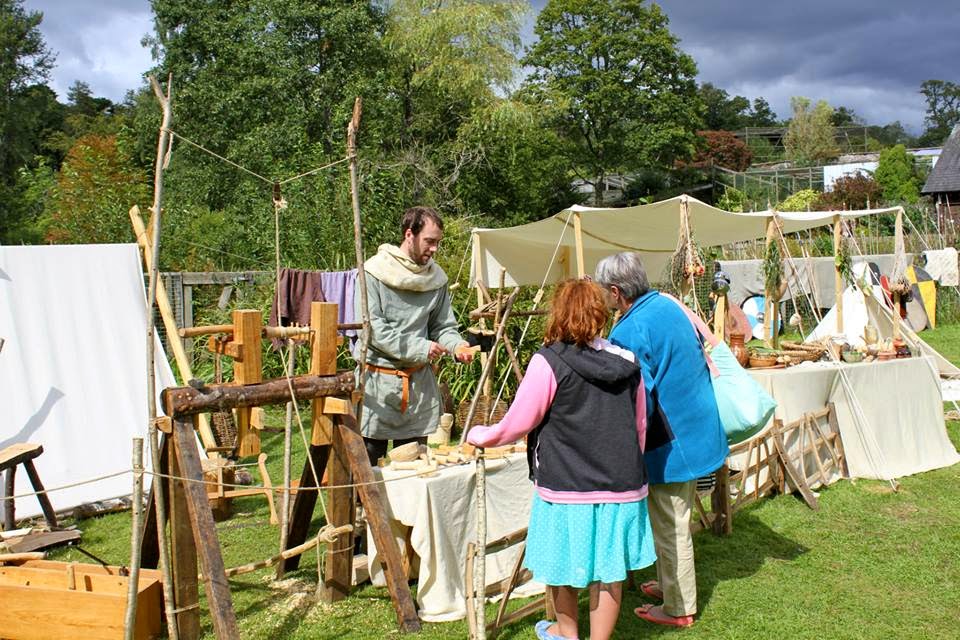
Recently I got some horn. I had wanted four small cow horns to utilise but I ended up with three nice small horns and one huge horn! I did not expect this. As I had such a large horn and not much use for it I decided I would try out making a horn spoon. I've never done it before and am always willing to try new crafts once! So this is what I did:

Step 1

I took the large horn and cut it in half so I was left with two pieces. The top piece (the larger piece) I then cut in half length ways ready for boiling.


Step 2

I placed one half in a cauldron of boiling water over a fire. The heat from the water makes the horn become more flexible and able to be shaped, or in my case flattened out. Once it was hot enough I removed it from the water for flattening.


 Step 3

I put the horn on a flat piece of wood then popped half a log on top of it and applied pressure. This flattened the flexible horn which meant I could then use it for spoon making.


Step 4

Now the horn was flat I could start cutting a spoon shape. I did this using a hack saw and a coping saw to give me the rough shape.


Step 5

Once cut I could use an abrasive material, like sandstone, to smooth the rough edges of the horn and polish it slightly. Once this was done I could then boil it again and shape the bowl of the spoon making a functional and usable utensil!


Bertram's Bio:

Born near Daltune (Dalton-in-Furness) in 1116 Bertram had a hard start to life working the farm lands with his parents and brother Ernolf. In his teenage years he developed a passion for woodwork and enhanced his skills on a pole lathe. Now, when he isn't working the land, he travels the county selling his wares where he can to earn a crust. Making all sorts of wooden objects from bowls to spoons and even toys Bertram has gained a reputation for quality goods in many parts of the county and just about manages to stay afloat. 


Thursday, 20 November 2014

Iron Shepherds Living History Turns Two!

Another year passes for Iron Shepherds and plenty has happened over it; from new displays to new events and exciting opportunities!

December 2013

Medieval Camp at a Christmas Fair | 01.12.2013

Our second year started off at a leisurely pace with our first event being another winter fair at Abbey Mill Cafe. We had a small camp set up where we spent the day preparing food, showing some crafts and generally trying to keep warm! It may look realitivly warm in the picture but it was a typical freezing winters day. Luckily we did have the fire to sit by and warm us up but our feet did get a little numb. Even so it was a great little day and a wonderful start to our second year before going on a little break.


 Following the winter fair we went on a break from events for the rest of the winter while we gathered ideas and worked on the summer to come!

May 2014

Monks at Furness Abbey | 05.05.2014

Brand new for 2014 Iron Shepherds introduced our Monks Life Display, a display tailor made to showcase different aspects of a monks everyday life from when they got up, to what they ate and what chores they had. The setting for our first Monks Life event was amongst the beautiful ruins of Furness Abbey. Sat in the cloister range we had a small display which had Brother Bertram demonstrating and talking about cooking, Brother Oswald net making, Brother Orm Tethera discussing everyday life, Brother Fulk giving insight into the lay brothers and Brother Ralph informing about surgery and health. The day saw a fair number of people coming to see us and learn about the Monks of Furness Abbey in an interesting and visually engaging way!


Monks Life at Furness Abbey | 24.05.2014

A few weeks after our first Monks Life event we were asked to do it again at Furness Abbey to coincide with some shuttle buses that were running on the 24th between the Abbey and the Dock Museum in Barrow. It was the perfect time to have a little extra going on in the ruins so we jumped at the chance to go down and set up our display again. This time, along with the original Brothers, we had a visiting Nun, Sister Æowyn and Brother Mellitus joined us to display ink making. The day was wonderful and we had lots of visitors from the shuttle buses as well as general tourists! 


June 2014

Holker Garden Festival | 30.05-01.06.2014

At the end of May we had the opportunity to have a small display at the Holker Garden Festival, and opportunity we jumped at! We had a small area to set up in to advertise ourselves so Bertram, Anna and Brother Orm Tethera headed up to the Festival to demonstrated some crafts, wares and entertain the crowds. We had lots of interest and positive feedback which was a real boost on the long hot days! We were in a tent which made it extra warm!


Dalton Carnival | 14.06.2014


A different sort of event for us this. We had been asked to be involved in the 2014 Dalton Carnival so that the carnival theme could be Medieval. We were happy to be involved and on the 14th we set up camp on Dowdales School field and then some of us went off to be in the parade! Brother Orm Tethera was joined by Oswald, Aelswyth and family to lead the parade through the streets of Dalton. Brother Tethera had quite a lot of fun engaging with the onlooking crowds! After the parade we performed our weapons display before everyone rejoined the camp to show off our crafts. It was a nice little day with masses of people enjoying the festivities. We had quite a fair amount come over and talk to us which made the day pass well.


 Family Fun Day at Gleaston | 28.06.2014

The end of June came and we had been invited to have a display at the Gleaston Family Fun day. The event lasted 4 hours from 12pm and we were there with our Anglo Norman camp to do what we do best, display crafts and engage with the public! We had a great day and spoke to many people who all showed an interest in what we had on show. Throughout the afternoon bowls were turned, nets were made and stone was carved!


August 2014

Muncaster Castle Living History Week | 19-20.08.2014

Here we are again, back for one of our big shows of the year at Muncaster Castle Living History Week! We set up camp for two days of education, entertainment and medieval fun and it was a real success!


Hundreds of people flocked in over the two days and wandered our camp asking questions, listening to explanations and enjoying the atmosphere of Anglo Norman life. We had many positive comments about what we were doing which really made the days worth while. The crowds for our weapons displays were a bonus too!


On our first evening at Muncaster, as we set up camp, we did a time-lapse video to show in speedy fashion how we erect our camp. It's certainly a fun little watch-


Medieval Fair at Furness Abbey | 30.08.2014

30th of August and it's time for another of our biggest events of the Summer, the Medieval Fair at Furness Abbey! And it didn't disappoint!


10am and the doors opened on the second ever Medieval Fair. Camp had been set up the night before and we were all up and ready for the public who soon arrived in their droves. There was a steady flow of people through out the day, walking through camp, chatting to us about our crafts and life in Anglo Norman Furness. We also performed our weapons display 3 times through the day to large crowds enlightening them to what weapons were used in the time as well as entertaining them with some brawls. 


While at the Abbey fair we also filmed another time-lapse video! This video was taken throughout the whole day, from 10am until about 6.30pm, and gives an idea of the numbers of people who flocked to the event and came through our camp!


October 2014

The Room of Curio at Wray Castle | 30+31.10.2014

And so arrives our final event of the year for us, a brand new venture created specially for Halloween; our Victorian Room of Curio! Showcased for the first time at Wray Castle during their halloween celebrations the idea was devised as a way to engage the public by telling them local stories and legends while also entertaining them with a couple of scares along the way. We had timed entry to the room throughout the two days where Curio Master, Dalton Mills, would take people round. We were booked up for all our entries with 160 people, young and old, entering the room over the time. Everyone left the room happy, entertained and a little bit scared and we received some really positive comments! Dalton Mills was certainly pleased with the reactions to his stories and curiosities.


It has been a fantastic year for us with so many new and exciting events as well as returning to some of our favourites. Thank you to all who have supported us, booked us and come to see us this past year. We have had a great time and are extremely excited to see what the next year brings, we certainly have some interesting ideas ...

If you would like to keep up to date with what the Iron Shepherds are doing then why not follow us on Facebook or Twitter  You can also check out our website to discover what we do and what we have coming up.